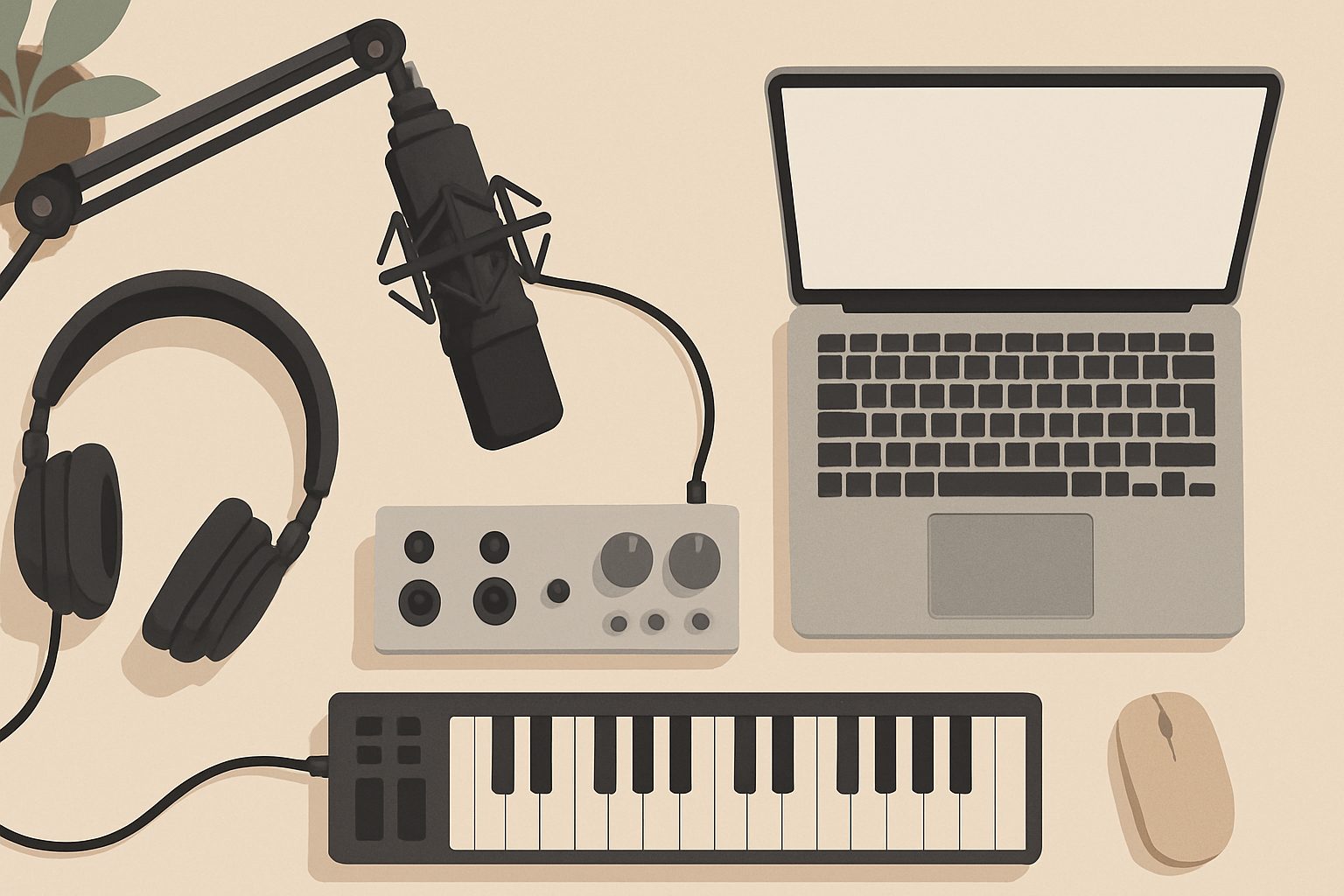
Best MIDI Keyboards and Controllers for Home Studios UK 2025
Choosing a MIDI controller can feel overwhelming—there are dozens of options, wildly different price points, and confusing specs. If you're setting up a home studio in the UK, though, you don't need the flashiest or largest controller. You need something that works with your space, your workflow, and your budget.
This guide covers three solid controllers that genuinely suit UK home studios: the Arturia MiniLab, Akai MPK Mini, and Native Instruments S-Series. We'll walk through the weighted-versus-semi-weighted question, help you pick the right size, and give you the honest pros and cons so you can decide.
Weighted vs Semi-weighted: What Actually Matters
The weight of keys determines how they feel and how much they cost. It's worth understanding because it affects your purchasing decision.
Semi-weighted keys (like those on the MiniLab and MPK Mini) are light and responsive. They require minimal finger movement and respond quickly to rapid input. They're ideal if you're triggering drums, loops, or short synth stabs. They take up less space and are cheaper to manufacture, which keeps prices low. For electronic music, hip-hop, and beat production, semi-weighted is often the better choice because speed matters more than piano realism.
Weighted keys (found on the Native Instruments S88 and some S49 models) use springs and mechanisms to mimic acoustic piano resistance. They require more finger pressure and have a slower, more deliberate response. They're better if you're learning piano technique, triggering long strings or pads, or working with traditional keyboard sounds. Weighted keys are heavier physically, which means the controller itself weighs more and takes up more desk space.
For most home studios in the UK, semi-weighted is the practical choice. It's cheaper, smaller, easier to fit into cramped rooms, and perfectly capable of producing professional music across genres.
Size: Picking What Fits Your Setup
MIDI controller size matters more than manufacturers suggest. A 49-key controller sounds reasonable in theory but can dominate a small bedroom.
25-key controllers (MiniLab, MPK Mini) are genuinely portable and desk-friendly. You can fit one comfortably on a laptop stand or slide it beside your monitor. The tradeoff is obvious: you're working in smaller ranges, and complex arrangements mean more octave-switching. For sampling-based production, beat-making, and live remixing, 25 keys is enough.
49-key controllers (entry-level option) are the middle ground. Enough keys for melody work without dominating your desk. Still portable if you need to move it.
88-key controllers (full-size keyboards like the S88) are serious instruments. They take up significant space, require dedicated stands, and aren't practical unless you have a dedicated studio room. Most home producers don't need this.
Measure your desk space before buying. A 25-key controller is roughly the width of a small laptop; a 49-key is noticeably wider.
Arturia MiniLab: Best for Beat Makers
The Arturia MiniLab is a genuinely clever 25-key controller. It's one of the smallest on the market without feeling like a toy.
The 25 semi-weighted keys are responsive and fast. Above the keys, you get eight knobs and eight faders—more physical controls than you'd expect at this size. That's useful if you're tweaking synth parameters, controlling reverb, or automating mixing. The build quality is solid; it doesn't feel cheap, though the plastic is plastic. It's lightweight enough to throw in a bag if you're collaborating elsewhere.
Connections include USB, MIDI In/Out, and sustain pedal input. The software integration is smooth if you're using Arturia plugins, but it works with anything. Setup is straightforward on Windows and Mac.
The downside: 25 keys is limiting if you want to play melodies across a wider range without constant octave-switching. The controls above the keys are handy but small and fiddly. It's not a beginner piano learning tool—it's built for producers and electronic musicians.
Best for: Beat makers, synth twiddlers, laptop-based producers who need hands-on control.
Akai MPK Mini: The Classic Compact Option
The Akai MPK Mini has been around for years and remains one of the best-selling compact controllers in the UK for good reason.
It's nearly identical to the MiniLab in terms of keys—25 semi-weighted—but the control layout is different. The MPK Mini features a grid of 16 pads (useful for triggering samples or launching clips), knobs, and a pitch-bend wheel. The pads are particularly good if you work with loop-based music or need fast percussion triggering.
Build quality is solid. It's durable and reliable, with a professional look that doesn't screams "budget gear." Unlike the MiniLab, it feels more like a standalone instrument and less like an extension of a DAW.
The software bundle is decent but minimal. Akai includes some decent sounds, but you're not getting the comprehensive suite that Arturia offers. Setup is simple, and it works cross-platform without faffing about.
The downside: the grid of pads takes space that could be additional controls. If you're more interested in knobs and faders (for mixing or synth control) than in triggering samples, the MPK Mini isn't the best fit.
Best for: Hip-hop and electronic producers, sample-based music, anyone who works with drum pads regularly.
Native Instruments S-Series: For Serious Work
If you've got more desk space and budget, the NI S49 or S88 are proper music-production controllers.
The S49 (49 keys) bridges the gap between portable and functional. The semi-weighted keys are more responsive than competitors, and the additional keys mean fewer octave shifts during playing. You get a solid number of knobs and faders for parameter control. The build is professional—it feels like proper gear, not a laptop accessory.
The S88 is the full 88-key version. It's weighted, expensive, and meant for studios where you're not compromising on space or budget.
Integration with Native Instruments software (Maschine, Komplete) is seamless, but it works with any DAW. The software included is genuinely good.
The downside: the S49 is too large for small desks, and the S88 isn't realistic for most UK home studios. They're overkill if you're primarily making electronic music or beats.
Best for: Producers who want to play melodies, learning keyboard skills, larger studios with dedicated space.
What to Choose
For a typical UK home studio: start with the Akai MPK Mini or Arturia MiniLab. Both are proven, affordable (around £100–150), and fit anywhere. Pick the MPK if you work with samples and pads; pick the MiniLab if you want more faders for mixing control.
If you've got space and budget: the S49 is a serious step up without the massive footprint of an 88-key. You're paying more (around £300–400), but you get better keys and professional build quality.
Avoid the temptation to buy the "full-size" option thinking it'll work better. It won't—it'll just annoy you.
More options
- Focusrite Scarlett Series Audio Interfaces (Amazon UK)
- Yamaha & Adam Audio Studio Monitors (Amazon UK)
- Audio-Technica & Rode Condenser Microphones (Amazon UK)
- Acoustic Foam Treatment Panels (Amazon UK)
- Arturia & Akai MIDI Keyboards and Controllers (Amazon UK)